No 31 Squadron RAAF
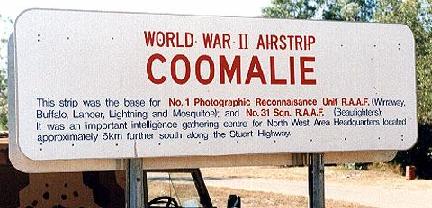
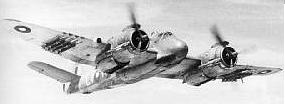
Equipped with Beaufighters, No 31 Squadron was formed at Forest Hill, (now Wagga Wagga airport), New South Wales on 14th August 1942, deploying to the Northern Territory to its base at Coomalie Creek, arriving on 12th November 1942.
[Note: The forces defending NW Australia in late 1942 were solely Australian. No 18 Squadron, a Dutch B-25 group and American B-24 Group were on the way in early 1943. 31 Squadron consisted of a full complement of 24 Beaufighters sharing Coomalie Creek Station with No 1 PRU (Photo Recon Unit) made up of 1 Whirraway, 4 Brewster Buffaloes and 2 Lightnings and 6 Lancers. Fighter defense at Darwin 150 kilometers to the northwest consisted of 48 Kittyhawks of 76 & 77 Squadrons based out of Livingstone and Strauss Airfields.]
Operations commenced on 17th November 1942 attacking Japanese targets in Timor and the islands north of Darwin. Operating at low level, Beaufighter attacks often caught the enemy by surprise as demonstrated when a formation of No 31 Squadron Beaufighters caught forty Japanese fighters and bombers on the ground at Penfoei. Surprise was complete and eighteen aircraft were destroyed for no loss.
Another successful strike was made against Penfoei airfield in February 1943 when twelve aircraft were destroyed and ten damaged despite strong fighter opposition and heavy anti-aircraft fire.
Soon after this operation, No 31 Squadron concentrated its efforts on destroying an important Japanese reconnaissance and flying boat base base at Taberfane in the Aru Islands. The first operation was flown on 6 May when five Beaufighters destroyed nine enemy aircraft on the water. On 4 June, four Beaufighters were engaged over Taberfane by nine floatplanes, resulting in three enemy aircraft shot down for no loss. A week later, the Squadron destroyed seven floatplanes on the water and severely damaged another two. Successful attacks against this base continued despite increased anti-aircraft defences until eventually, the Japanese were unable to sustain their losses and evacuated Taberfane.
By the end of the war, No 31 Squadron had destroyed 54 aircraft and nine ships, and seriously damaged a further four ships.
The Beaufighter's armament was steadily upgraded during the war, firstly with the addition of underwing bombs and later, wing mounted rockets were installed. Rockets arrived at the squadron in late September 1944 and the first rocket attack was made on 16th November 1944.
31 Squadron moved from Coomalie Creek to Noemfoor Island on 1 Dec 1944 and on 6 December it was in the air for 6 hours and 10 mins searching (without success) for a lost RAAF Kittyhawk pilot in the Macclear Gulf.
On 7th December 1944 the squadron moved to Morotai, replacing 22 Squadron, and joining with 30 Squadron to form No 77 Wing. Operations began on 9 Dec with the first joint operation with 30 Squadron, led by the CO, SqnLdr Pat Boyd DFC and Bar, in a long sortie up to Jolo Island, in the southern Phillipines. 17 aircraft participated and all returned safely after encountering only light AA over the target area.
The Squadron's impressive wartime achievements came to an end when the Squadron returned to Australia and was disbanded on 6th July 1946.
On 1st July 2010, the Squadron was again reformed and is now operating as
No 31 (CITY OF WAGGA WAGGA) SQUADRON
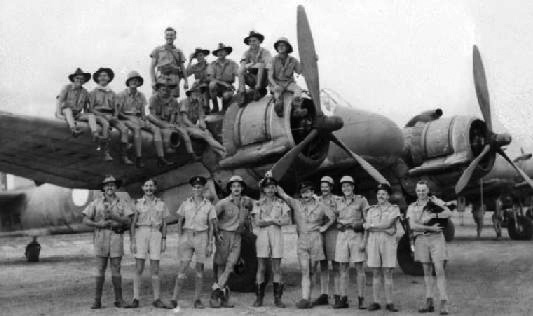
This squadron photo was taken at Coomalie strip in 1942.
Pilots on the ground, Navs on the aircraft.
Pilots on the ground left to right::
Cormie, Madden, Savage, Barnett, Cooke, Greenwood, Delaporte, Biven, Entwhistle, Van Nooten.
Navigators on wing left to right::
Agnew, Hatfield, Newton, Studt, unknown.
Navigators on back and engine left to right::
Thorncraft, unknown, Thompson, Meers, Lennon.